|
|
Welcome to the NCTCOG Center of
Development Excellence Newsletter!
|
|
|
|
|
|
|
|
|
|
|
Regional Colleges & Universities Highlight
|
|
|
- Rewilding the Campus: Restoring Ecosystems at Dallas College
|
|
|
|
|
|
|
|
|
- Utility-Scale Solar Shines in Texas Despite Tariffs, Federal Policy Change
- Northside Fort Worth a Year Later: Planning Growth Without Displacement
- Giant Fort Worth Plant Diverts Millions of Pounds of E-Waste from Landfill
- How North Texas Leaders are Thinking about Region's Water Future as Challenges Mount
- Senate Moves Historic Housing Legislation Forward with 21st Century ROAD to Housing
Act
|
|
|
|
|
|
|
|
|
- 2026 South Central Climate Resilience Forum
- Regional Integration of Sustainability Efforts (RISE) Coalition Quarterly Meeting
- 2026 Humid Climate Conference
- Greater & Greener 2026
- Lone Star Sustainability Forum 2026
|
|
|
|
|
|
|
|
|
|
|
- SECO Community Centers Energy Efficiency Retrofits for the State Energy Program
- Texas Volkswagen Environmental Mitigation Program Application Deadline Extended
|
|
|
|
|
|
|
|
|
Regional Colleges & Universities Highlight
|
|
|
|
|
|
Rewilding the Campus: Restoring Ecosystems at Dallas College
|
|
|
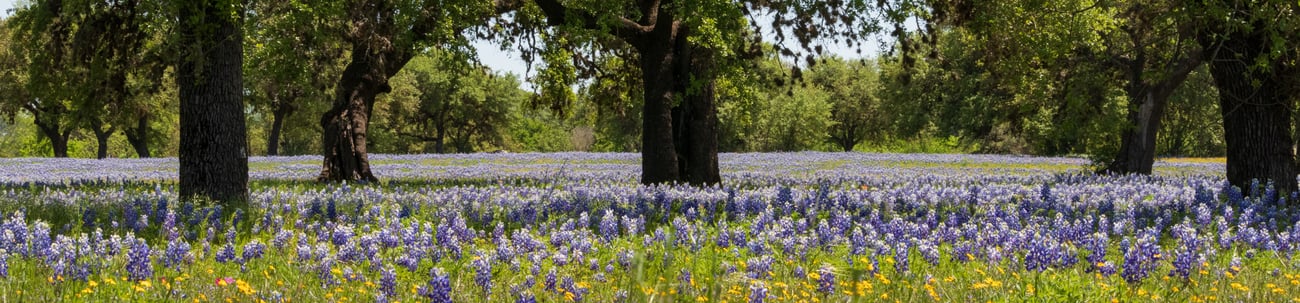
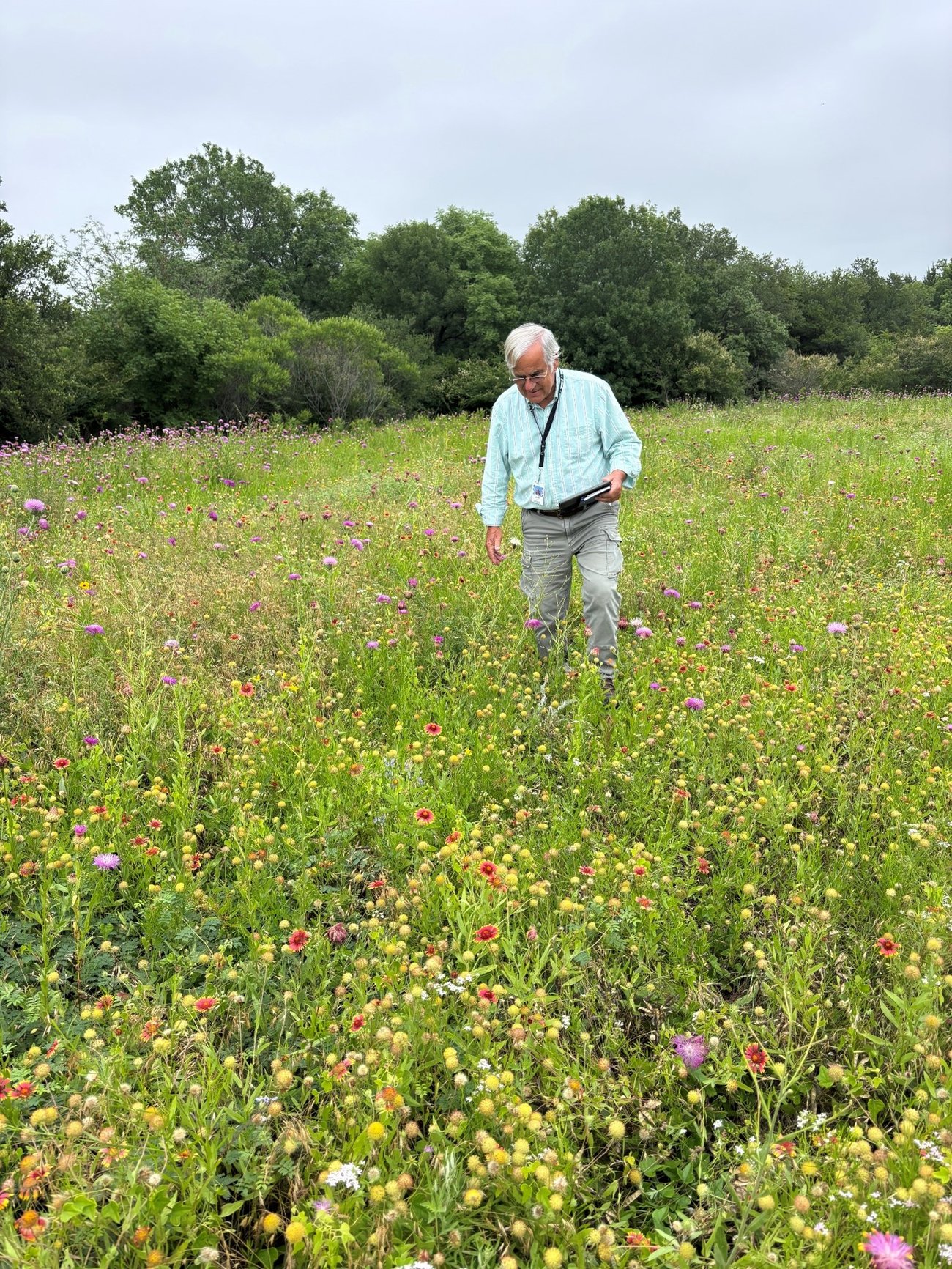
College campuses are a place for learning. It should also be a place where wildlife thrives, built by and for the larger student community. That is the aim of Dallas College as it works to convert another 40 acres of its minimally managed land into a restored prairie. John Wilt, the Conservation Project Lead for the Office of Sustainability, spends his workdays removing invasive plants, watering new plants, and planning volunteer events.
The conservation efforts have not been without speed bumps. One of the biggest challenges is managing invasive plants. The privet (Ligustrum quihui) is one of the most pernicious weeds in forested areas. It is an evergreen shrub that will fill in the understory and block out all light for native plants. It takes aggressive mechanical and chemical treatment to hold them back.
|
|
|
|
|
|
| Another invasive challenger is the King Ranch (KR) Bluestem (Bothriochloa ischaemum). This noxious grass chokes out native grasses and forbs. John utilizes a few different chemicals to treat the invasive grass that has blanketed the prairie. Once he knows that the KR Bluestem is not going to grow back, he tills the soil and reseeds with a blend of native grasses and forbs.
|
|
|
|
|
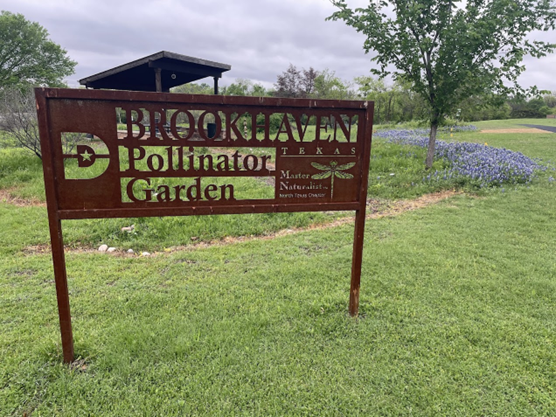
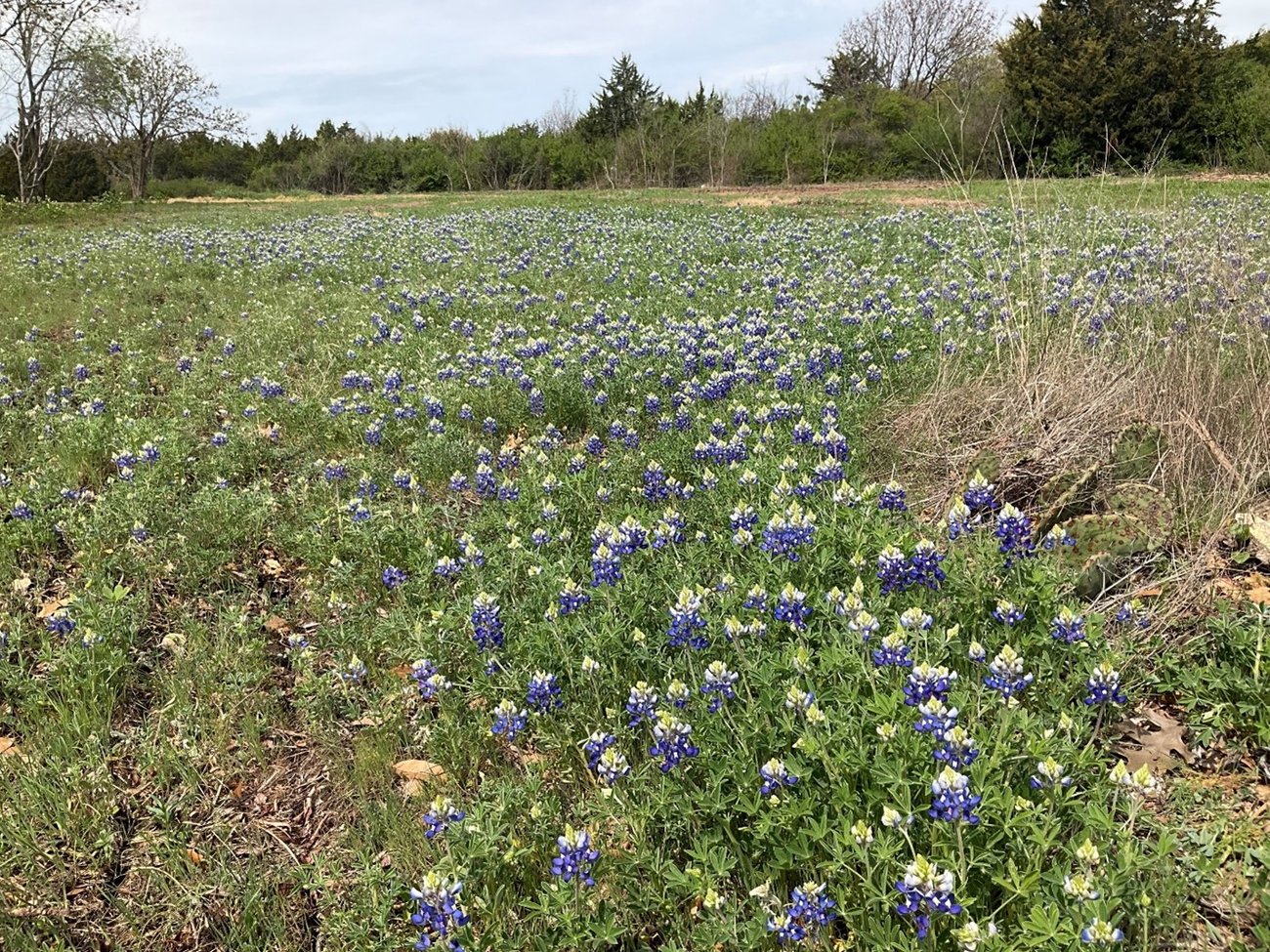
John’s two-year tenure with Dallas College has been very productive. He worked with the Brookhaven campus to add a half-acre prairie, the Cedar Valley campus to restore six acres of forest and another six acres of prairie, and the Mountain View campus to restore two acres to a tall grass prairie. The Eastfield campus is next, as John and the Office of Sustainability plan to partner with the Caeser Kleberg Wildlife Research Institute to treat invasives and install native plants on a contiguous 40 acres.
There is a thin line between unmanaged land and a tall grass prairie in the winter. The biggest lesson learned was that intentionality matters. That means having interpretive signage, tree walks, and maintained trails.
These conservation projects will reopen areas to the community for all kinds of recreation: hikers, birders, and picnickers alike. Everyone wins when college students are interfacing with the community through the lens of conservation.
|
|
|
|
|
|
|
| This article was submitted by Neil Kaufman, Assistant Director of Sustainability in Urban Agriculture at Dallas College. Original article has been edited for clarity and length.
|
|
|
|
|
|
|
Utility-Scale Solar Shines in Texas Despite Tariffs, Federal Policy Changes
|
|
|
In 2025, Texas took the lead as the top state for utility-scale solar power generation capacity, seeing solar capacity continue to grow at the same rate it did in 2024. Solar has seen increased investor interest relative to other forms of
energy due to its low cost, which when paired with Texas’s many hours of clear, sunny skies, has resulted in increasing solar power economies across the state.
Federal tax credits have also helped push for solar adoption, with an investment credit first being enacted in 1978 and further extended under the Energy Policy Act of 2005 and the 2022 Inflation Reduction Act.
However, solar has faced challenges due to shifts in the operating environment. Inflation Reduction Act tax credits will be phased out after 2027 due to terms in the One Big Beautiful Bill Act. Additional challenges have been seen as the imported solar panels many solar projects rely on have been heavily impacted by tariffs, resulting in a decrease in imports.
Despite these challenges, solar in Texas continues to grow, with demand projected to increase over the next five years as data centers, crypto mining, and other new industrial customers move into the state. Learn more about the future of utility-scale solar in Texas here.
|
|
|
Northside Fort Worth a Year Later: Planning Growth Without Displacement
|
|
|
One year ago, the Fort Worth Hispanic Chamber of Commerce and city government invited an Urban Land Institute (ULI) Advisory Services Panel to help in addressing mounting displacement pressure on the Northside, a predominantly Latino neighborhood facing rising property values and growing concerns about cultural displacement. The panel has played a significant role in
advancing community engagement, advancing efforts such as an immersive real estate development and education program and the creation of a community action committee.
To ensure that funding does not get in the way of implementing the recommendations made by the Advisory Services Panel, ULI Dallas – Fort Worth committed $45,000 in implementation funding. Funds will go towards initiatives identified in further public panel discussions, including district planning, design guidance, zoning refinements, and a cultural asset mapping effort. As work to include neighborhood residents and stakeholders in the development process continues, the chamber hopes these proactive efforts will respect the character of the Northside and keep development efforts streamlined. To read more about the work being done in the Northside and ongoing plans for the region, visit ULI’s website.
|
|
|
Giant Fort Worth Plant Diverts Millions of Pounds of E-Waste from Landfill
|
|
|
Nestled in an industrial district in North Fort Worth sits a massive electronics recycling operator, Universal Recycling Technologies (URT). Currently serving as the largest recycling operation of its kind in the southwestern United States, URT processes more than 10 million pounds of electronic waste (e-waste) per year. Given that the average American family generates about 115 pounds of e-waste each year, with more than 80% of that waste going to landfills, facilities like URT are critical to diverting e-waste
through reusing, repurposing, and recycling. Most e-waste is received from businesses, banks, school districts, manufacturers, non-profits, and local governments. URT logs, inspects, and verifies the waste before it is sorted and prepared for processing, where materials like refrigerants and metals are extracted and recovered before being shipped out. These efforts are in support of their "lifecycle solutions" model, which evaluates every item for its optimal outcome. Learn more about these important e-waste recycling efforts here.
|
|
|
How North Texas Leaders are Thinking about Region's Water Future as Challenges Mount
|
|
|
|
|
Senate Moves Historic Housing Legislation Forward with 21st Century ROAD to Housing Act
|
|
|
|
|
|
|
|
|
2026 South Central Climate Resilience Forum
|
|
|
The South Central Climate Resilience Forum (SCCRF) will bring together representatives from non-profit organizations, all levels of government, community groups, the private sector, and academia from all over the country. The goals of the event are to improve understanding of the climate-related challenges facing the region and increase awareness of work that is being done to enhance resilience in the region. The program will include
presentations, symposiums, and workshops on resources, research, tools, knowledge, and experiences, and will provide opportunities for information exchange and network-building.
The three-day event is being held in-person on April 15-17, 2026 in San Antonio, Texas. The event will focus on fostering meaningful dialogue and action on climate resilience and adaptation across the region.
Registration information and the Forum program can be found on the Forum website.
|
|
|
Regional Integration of Sustainability Efforts (RISE) Coalition Quarterly Meeting
|
|
|
|
|
The next RISE Coalition meeting is scheduled for April 29, 2026, at 9:30 AM. The meeting will be held in-person at NCTCOG Offices. If you are interested in attending, please RSVP here.
For more information
about the RISE Coalition, visit the RISE Coalition website. The RISE Coalition website provides information about past and upcoming meetings.
|
|
|
|
|
2026 Humid Climate Conference
|
|
|
The Humid Climate Conference (HCC2026) is making its biennial reappearance May 4-5, 2026. Passive House Austin is thrilled to invite attendees to listen, learn, and network with industry thought leaders, boots-on-the-ground overachievers, and a fantastic mix of manufacturer sponsors. Join architects, builders, engineers, energy consultants, and more to learn about the issues and causes that prevent better building design and creation, as well as solutions
and next actions. Topics covered include: - The energy transition;
- The refrigerant transition;
- The (embodied) carbon transition;
- Transitions underway in high performance enclosure design;
- Mechanical, Electrical, and Plumbing engineering; and
- The policy landscape.
Registration is now open. To purchase conference tickets,
please visit the HCC2026 website.
|
|
|
|
|
City Parks Alliance, in partnership with Austin Parks and Recreation and The Trail Conservancy, is hosting the Greater & Greener Conference June 13-16, 2026 in Austin, Texas. The conference will provide a unique opportunity for urban park leaders, planning and design professionals, public officials, nonprofits, community-based
organizations, advocates, and funders to network with an exceptional audience of key decision-makers from across the global urban parks community. It is the only event dedicated to exploring the full potential of parks as city-building tools. Greater & Greener will host a blend of indoor sessions and outdoor experiences that bring the power of parks to life. Attendees will take home strategies and tools for using parks to build more sustainable, vibrant, and equitable cities. Additional information and registration can be found on the Greater & Greener website.
|
|
|
Lone Star Sustainability Forum 2026
|
|
|
|
|
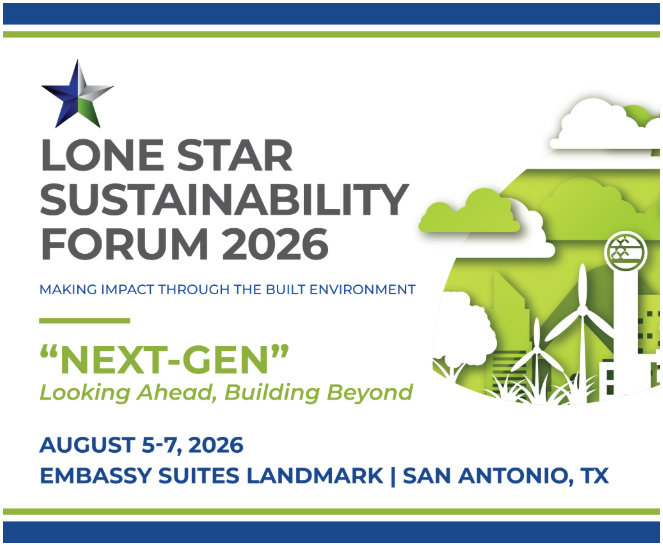
The Institute for Leadership in Capital Projects (I-LinCP) is hosting their 2026 Lone Star Sustainability Forum August 5-7, 2026 in San Antonio, Texas. This year’s Forum will focus on the built environment with the theme "NEXT-GEN - Looking Ahead. Building Beyond." This year’s Forum will explore what’s on the horizon for
the built environment: the innovations, technologies, and mindsets that are reshaping how we design, build, and lead. It will provide an engaging platform for diverse perspectives of professionals, do-ers, and visionaries, where collaboration, knowledge sharing, and actionable insights are paramount. Through bold keynotes, interactive panels, and hands-on collaboration, the 2026 Forum will challenge us to think beyond today’s goals and design for tomorrow’s possibilities. Registration is now open. For additional information, please visit the 2026 Lone Star Sustainability Forum website.
|
|
|
|
|
|
|
SECO Community Centers Energy Efficiency Retrofits for the State Energy Program
|
|
|
The State Energy Conservation Office (SECO) is currently accepting applications from eligible Community Centers to receive low-interest loan funding for energy efficiency retrofit projects. Taxpayer-supported, publicly owned community centers must provide services and support for people with intellectual and development disabilities, serious mental illness, and substance use disorders to qualify for the loan. Community Centers must be established and operated by a county, municipality, hospital district, school district,
or an organizational combination of two or more of those local agencies to qualify. Energy retrofit projects may be implemented using Design-Build, Design-Bid-Build, energy savings performance contracts, or Commissioning approaches. Successful applicants may borrow up to $2,000,000 per application, with approximately $16,000,000 in reimbursable loan funding to be available. Applications are being accepted through June 5, 2026, and will be reviewed on a first-come, first-served basis during the application period. More information about the loan can be found on the SECO website.
|
|
|
Texas Volkswagen Environment Mitigation Program (TxVEMP)
|
|
|
The application has been extended for the Texas Volkswagen Environmental Mitigation Program (TxVEMP). Individuals, state and local governments, corporations, and any other legal entity are invited to apply for
funding to replace or upgrade vehicles and equipment with electric alternatives. The following categories are eligible for funding:
- Class 8 Local Freight and Port Drayage Trucks
- Class 4-8 School Bus, Shuttle Bus, & Transit Buses
- Class 4-7 Local Freight Trucks
- Airport Ground Support Equipment
- Forklift and Port Cargo
Handling Equipment
- Refueling Infrastructure
|
|
|
|
|
The Center of Development Excellence (Center) is a regional program in North Central Texas that is built on
collaborative partnerships with a variety of stakeholders including local governments, businesses, private sector professionals and organizations, non-profits, and the public. The Center works to leverage opportunities and funding to create a North Central Texas region that is resilient, sustainable, and provides a high quality of life for residents. To learn more, visit the Center of Development Excellence website.
|
|
|
For questions or additional information on
any of these items, please contact:
Corinne Buckley
Environment and Development Planner
cbuckley@nctcog.org
817-704-2510
|
|
|
|
|
NCTCOG Environment & Development
616 Six Flags Drive
Arlington, TX 76011
United States
|
|
|
|
|
|
|
|